
The Ultimate Guide to Official Pickleball Court Dimensions
Pickleball has officially taken over. From neighborhood cul-de-sacs to high-end athletic clubs across the United States, the “pop-pop” of the paddle is the new soundtrack of American recreation.
But as the game evolves from a backyard pastime into a competitive pursuit, players are realizing that the quality of their game is only as good as the surface beneath their feet.
Whether you are looking to install a professional complex or wondering if you can squeeze a game into your backyard, understanding precise pickleball court dimensions is the first step. Here is everything you need to know to build a court that looks, plays, and lasts like a pro circuit.
Official Pickleball Court Dimensions

A standard pickleball court is smaller than a tennis court, but every inch is designed for high-intensity, fast-paced action. Unlike other sports, the dimensions remain the same for both singles and doubles play.
- The Playing Area: The official boundary lines measure 20 feet by 44 feet.
- Total Surface Area: To play safely and chase down lobs, you need more than just the boundary lines. The minimum recommended surface area is 30’ x 60’, though the “Gold Standard” for tournament play is 34’ x 64’.
- The Net: A professional net stands 36 inches high at the sidelines and drapes to 34 inches at the center.
Using the right measurement ensures that your “home court advantage” translates to any tournament in the country.
Anatomy of the Court: Lines and Zones

A court is more than just a rectangle; it’s a strategic map. To play by the official pickleball rules, your construction must include:
The Kitchen (Non-Volley Zone)
This is the most iconic part of a pickleball court. The “Kitchen” is a 7-foot area on both sides of the net where players are prohibited from volleying the ball. Precise marking here is vital to prevent mid-game arguments.
The Service Area
Behind the Kitchen, the court is split into two service areas (the left and right service courts), each measuring 10’ x 15’. These are divided by a 2-inch-wide centerline.
“Can I Turn My Driveway into a Pickleball Court?”

It’s the most common question we hear, and the answer is a resounding yes.
An asphalt driveway provides an excellent foundation for a court. However, a professional-grade experience requires more than just some tape. To turn a driveway into a true home court, you must consider:
- Orientation: Ideally, courts should run North-South to keep the sun out of players’ eyes.
- The Surface: Standard driveway asphalt can be abrasive. Applying a professional acrylic coating protects the feet of the players and ensures a consistent ball bounce.
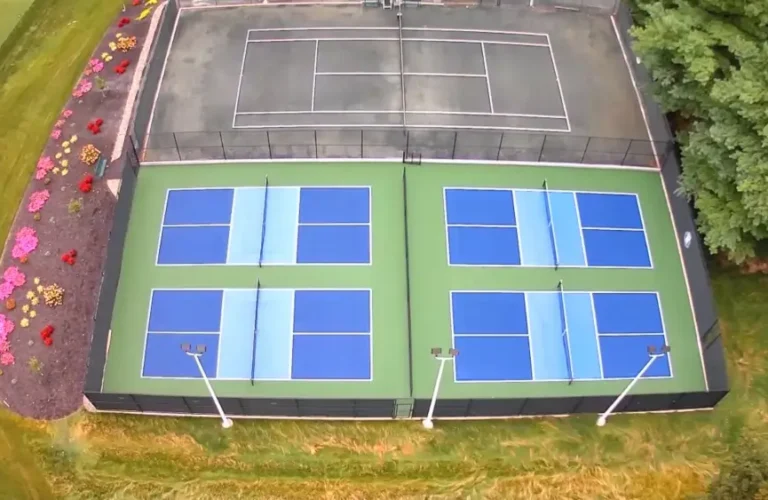
Inspiration: Don’t just paint lines on old pavement. Imagine a vibrant, dual-tone blue and green court that turns your driveway into the most popular spot on the block.
Explore our residential pickleball resources for more ideas.
Pickleball vs. Tennis: Maximize Your Square Footage

If you have an underutilized tennis court, you are sitting on a gold mine. Because of the compact dimensions of pickleball courts, you can fit four pickleball courts in the space of one standard tennis court.
This is a game-changer for HOAs and municipal parks looking to increase engagement without expanding their physical footprint.
Check out our recent projects to see how we’ve transformed aging tennis surfaces into thriving pickleball hubs.
Why Professional Construction Matters

While you can DIY a temporary court with some chalk and a portable net, a permanent court is an investment in your property.
Professional construction ensures proper drainage (to prevent “birdbaths” or puddles), a perfectly leveled surface, and high-visibility markings that won’t fade after one season.
At Lancaster Asphalt, we specialize in the precision required for athletic surfaces. From the initial layout to the final acrylic coat, we make sure your court meets every United States Pickleball Association (USAPA) standard.
Ready to Build Your Dream Court?
Don’t settle for “close enough.” Give your game the surface it deserves. Whether you’re a homeowner looking for a backyard retreat or a facility manager planning a multi-court installation, we’re here to help.